
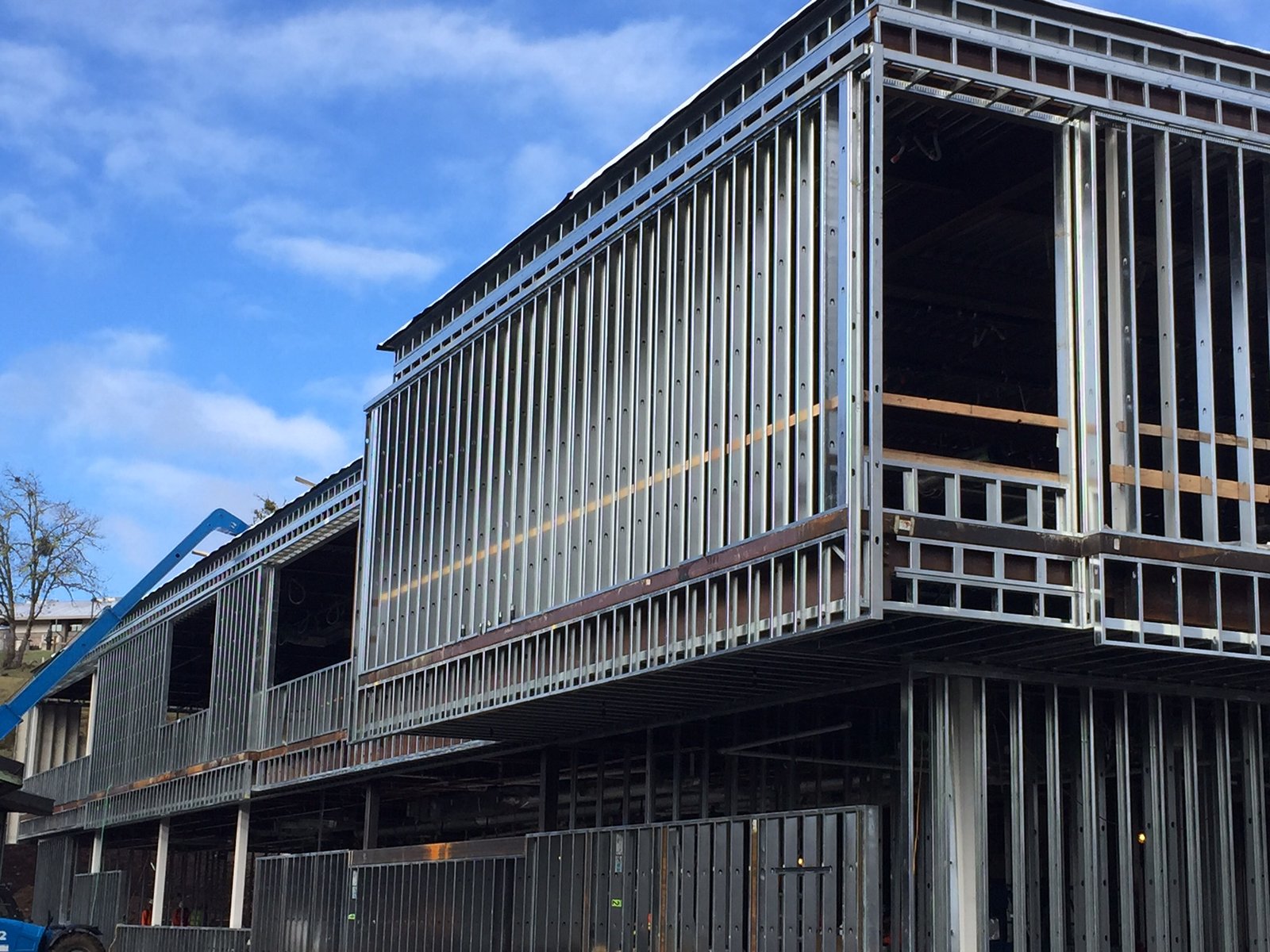
Steel Stud Framing vs Wood Framing: Which Is Better for Commercial Interiors?
The Evolution of Interior Wall Framing in Commercial Construction
When engineering interior partitions for commercial office buildings, retail storefronts, healthcare facilities, and multi-family residential towers across Surrey and the Lower Mainland, selecting the appropriate framing substrate directly impacts long-term structural integrity, fire compliance, and acoustic performance.
While traditional dimensional lumber remains popular in single-family residential framing, cold-formed steel (CFS) stud framing has become the indisputable industry standard for commercial tenant improvements and modern multi-storey construction.
1. Dimensional Stability & Laser-Straight Finishes
Wood is an organic, hygroscopic material prone to twisting, warping, crowning, and shrinking as interior relative humidity shifts. In contrast, cold-formed steel studs manufactured to ASTM standards maintain exact dimensional uniformity. Steel does not warp or bow over time, eliminating joint cracking, drywall fastener pops, and uneven wall planes — critical prerequisites for pristine Level 4 and Level 5 drywall finishes.
2. Non-Combustibility & British Columbia Building Code
Under the BC Building Code and local municipal bylaws in Surrey, Abbotsford, and Vancouver, non-combustible construction is strictly mandated for major commercial occupancies, demising walls, corridor partitions, and high-rise assemblies. Steel studs provide 0-flame spread ratings and integrate seamlessly with Type X gypsum board to achieve certified 1-hour, 2-hour, and 3-hour fire-resistance ratings without chemical fire-retardant treatments.
3. Weight-to-Strength Ratio & Structural Efficiency
Light-gauge steel studs are up to 60% lighter than equivalent dimensional timber studs while offering superior axial and lateral load capacities. This significantly reduces dead load on floor slabs in multi-storey builds and enables taller unsupported spans in high-ceiling retail and warehouse environments.
4. Acoustic Performance & Resilience
Steel studs possess a narrower flange and natural mechanical flexibility that creates a resilient decoupling effect. When combined with sound attenuation batts (mineral wool) and acoustic sealant, steel stud wall assemblies consistently achieve higher Sound Transmission Class (STC) ratings than rigid wood studs, making them ideal for commercial boardrooms, medical clinics, and multi-tenant demising walls.
Planning a Commercial Interior in Surrey?
Arcadian Steel Pro’s Ltd. specializes in commercial light-gauge and heavy-gauge structural steel framing across Surrey and the Fraser Valley.
Explore Our Steel Stud Framing Services →Summary Table: Steel Studs vs. Wood Studs
- Fire Resistance: Steel is non-combustible (Class A); Wood is combustible.
- Moisture & Mold: Steel is impervious to mold, rot, and termites; Wood absorbs ambient moisture.
- Wall Straightness: Steel guarantees true 90-degree corners and flat planes; Wood crowns and warps.
- Acoustic Isolation: Steel assemblies achieve superior STC ratings through structural decoupling.
Have a Similar Project?
Get direct contractor pricing on steel stud framing, drywall, acoustic drop ceilings, or soundproofing.
Request a Free Quote Call +1 (778) 814-1360